When fire suppression efforts cease in hillside residences in Pacific Palisades or commercial properties along Olympic Boulevard in Koreatown, paper archives and digital media face dual-vector damage. High-velocity…
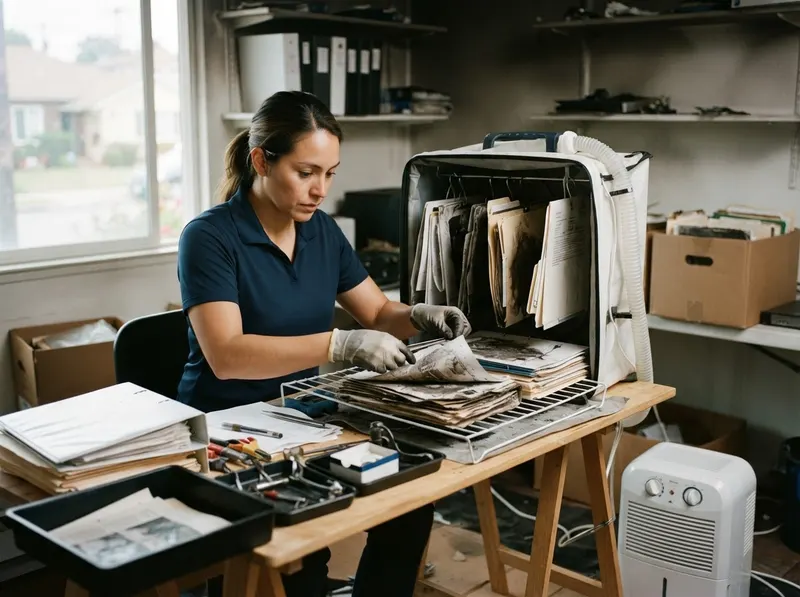
When fire suppression efforts cease in hillside residences in Pacific Palisades or commercial properties along Olympic Boulevard in Koreatown, paper archives and digital media face dual-vector damage. High-velocity hose lines discharge hundreds of gallons of water into framing assemblies, saturating file cabinets and home offices before structural soot completely settles. In Los Angeles County's coastal and valley climates, moist cellulose binds with acidic soot particulates within 48 hours, causing irreversible fiber swelling, ink migration, and rapid mold colonization. Prime Fire Damage Restoration applies clinical stabilization protocols to halt degradation immediately upon retrieval, separating salvageable records from non-restorable debris according to strict chain-of-custody protocols.
Vacuum freeze drying serves as the primary technical recovery method for waterlogged paper documents. By freezing saturated paper to temperatures below -20 degrees Fahrenheit and lowering ambient pressure inside a sealed chamber, ice crystals sublimate directly into vapor without re-entering a liquid state. This prevents page adhesion, ink dissolution, and page cockling across fragile materials like legal briefs, escrow titles, and historical vellum blueprints found in older estates across Silver Lake, Los Feliz, and Brentwood. For digital media, including external hard drives, solid-state storage, and magnetic tape retrieved from properties in Studio City or Encino, technicians utilize cleanroom particulate removal and desiccant chamber drying to arrest galvanic corrosion across circuit boards before data extraction takes place.
Choosing thermal stabilization versus field air-drying represents a critical trade-off between structural integrity and recovery speed. Direct convective air-drying causes non-uniform evaporation, which leaves standard 20-pound bond paper warped, brittle, and permanently distorted while sealing acidic smoke residues into the fibers. Sublimation chambers require a 7 to 21-day cycle, yet preserve structural flatness and ensure archival readability. If water saturation exceeds 30 percent moisture content by weight, vacuum freeze drying is mandatory to avoid structural decay; if materials suffer only superficial dry soot accumulation without water contact, high-efficiency particulate air (HEPA) surface sponging and chemical sponge de-sooting provide rapid remediation without thermal treatment.
Field recovery in multi-story apartment units in Boyle Heights or valley homes in Northridge requires precise transit triage through heavy Los Angeles traffic. Prime Fire Damage Restoration implements on-site thermal blast-freezing to stabilize materials at the loss site before transport across Interstate 10 or the US-101 corridor. This step locks microbial activity at zero percent metabolic progress during transport, ensuring that transit delays never jeopardize the salvage potential of delicate historical, medical, or corporate records.
Every job gets a firm, written price after a free on-site visit.
Tell us about your document drying and media recovery job in los angeles and we'll send a clear, written quote, usually the same day.
 Prime Fire Damage Restoration